


Series Review: The Testaments
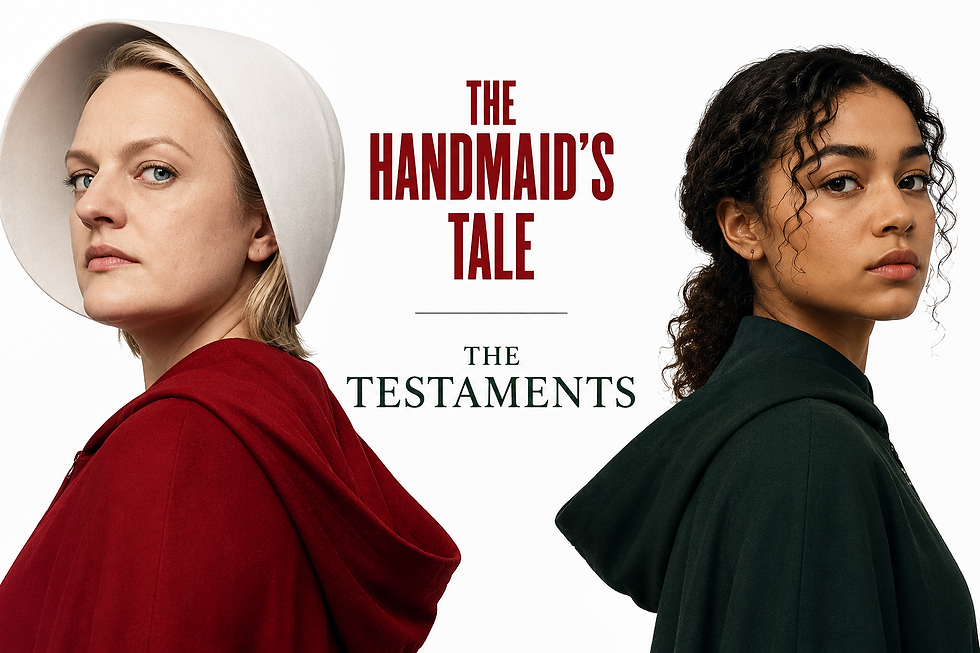
You cannot watch The Testaments in a vacuum. You simply can’t. It has to be viewed in relationship to The Handmaid’s Tale because the emotional weight of the entire series depends on what we already lived through with June, with Hannah, with Gilead itself.
I came into this series carrying years of fear, grief, rage, and exhaustion from The Handmaid’s Tale, and The Testaments smartly uses that history instead of trying to recreate it.
What surprised me was how many people apparently did not immediately realize Agnes was Hannah. Seriously? Even if you somehow missed the clues, the emotional DNA was there from the beginning. The guardedness. The intelligence. The quiet observation of everything happening around her. And Chase Infiniti absolutely owns the screen. Owns it. There are certain performers you can spot immediately, where the camera simply belongs to them the second they appear. She has that quality. Her performance as Agnes is layered with restraint, intelligence, fear, longing, and a strange inherited dignity that makes every scene feel alive underneath the dialogue. I would be stunned if there is not an Academy Award somewhere in her future.

And honestly, all three of the young women at the center of this series are remarkable. Truly remarkable. What they are doing here is not easy acting. They are playing girls raised inside repression who are only beginning to understand that something inside them does not fully fit the world they have inherited. That requires restraint. Nuance. Tiny emotional shifts. A flicker of doubt crossing a face that has been trained never to reveal doubt. A longing for friendship mixed with fear of saying the wrong thing. They are not performing rebellion loudly. They are performing the slow awakening of consciousness, and they do it beautifully.

Lucy Halliday brings Daisy a rawness and unpredictability that gives the series energy every time she appears. You feel her fighting internally even before the character fully understands what she is fighting against.
Rowan Blanchard as Shunammite is chilling in all the right ways, embodying the terrifying confidence of someone who completely believes in the hierarchy that gives her power.
Mattea Conforti gives Becka warmth and emotional accessibility that becomes one of the series’ quiet anchors. Even smaller performances linger. Isolde Ardies as Hulda understands exactly how dangerous insecurity can become inside rigid systems, and Mabel Li’s Aunt Vidala carries authority with an almost serene menace that makes her scenes deeply uncomfortable. None of these performances feel young in the inexperienced sense. They feel disciplined. Thoughtful. Controlled. The girls are not overacting emotion. They are revealing tiny cracks in people trained never to reveal anything at all.

For me, what makes The Testaments so compelling is that these young women were raised entirely inside Gilead. They are not remembering another life. They are not mourning freedoms they once had because many of them never experienced freedom at all. Their understanding of womanhood, friendship, marriage, faith, duty, and even safety was built completely inside this system. That changes everything psychologically.
And what fascinated me most is watching the tiny fractures begin anyway.
Because oppression does not eliminate ordinary girlhood. It reshapes it.
These girls still obsess over friendships. They still want approval from one another. They still whisper, compete, protect, judge, and form alliances exactly the way girls always have.
One of the smartest choices the series makes is showing how deeply social pressure operates inside Gilead among the girls themselves, not just from the men or the state.
There is enormous pressure surrounding puberty and menstruation because getting a period means entering the marriage marketplace. Becoming visible. Becoming valuable.
Entire emotional futures are tied to biology and timing. And then comes the husband question. Not “Will I love him?” Not even “Will he love me?” The standard is far lower and far more frightening. Will he be cruel? Will he have status? Will he embarrass the family? Will he hurt me? Love barely enters the conversation because these girls have not been raised to imagine marriage as emotional fulfillment. Marriage is placement. Security. Duty. Survival.
And what makes the series work is that the girls themselves often enforce these expectations on each other. That is how systems sustain themselves. Through social belonging.
Several critics have pointed to this shift in perspective as the series’ greatest strength.
Variety called it “a magnificent coming-of-age story” and praised the way it explores “the uniqueness of girlhood and how the patriarchy underestimates the power of female connection.”
The Guardian described it as “a study in groupthink,” while also noting that the younger protagonists bring an innate sense of hope to the series.
Even reviewers who were mixed on the show repeatedly praised the performances and the quieter emotional texture.
I actually think the acting may be better than in The Handmaid’s Tale. Not because it is bigger, but because it is more restrained. More nuanced.
The Handmaid’s Tale often existed in a constant state of emotional emergency, intentionally so. It was frantic, terrifying, exhausting. I was spent at the end of so many episodes.
Elisabeth Moss carried the audience through a kind of psychological warfare week after week. But The Testaments breathes differently. There is more stillness. More dignity. More ritual. Sometimes even moments of calm.
And honestly, that calm makes it more frightening to me.

Because authoritarian systems do not survive through terror alone. They survive through routine, aspiration, manners, hierarchy, and the illusion of stability. The Testaments understands that. Which is why it often feels more psychologically sophisticated than its predecessor.
And watching it now feels different than it would have ten years ago.
I found myself watching not simply as entertainment, but almost as a warning exercise. A chance to take notes. And I am making light of it. I'm serious. Deadly.
Because what makes Gilead possible is not simply religious extremism. It is economic imbalance. It is power concentrated into fewer and fewer hands while everyone else slowly becomes dependent on servicing those with access, wealth, influence, and protection.
I look around my country right now and I can already see the early architecture of that possibility. A shrinking ownership class. A growing service class. Entire industries being hollowed out by AI while political leadership seems more interested in protecting power than protecting citizens. People who once considered themselves stable, middle class, professionally secure, are beginning to realize how fragile their place actually is.
It seems entirely possible to me that within a decade many of the jobs available in this country will revolve around servicing the wealthy. Not because Americans are lazy or untalented, but because technology and political corruption together can hollow out opportunity extraordinarily fast.
The “have nots” of Gilead were not always have nots. That is the part people forget.
Systems shift. Economies shift. Power consolidates. Rights erode quietly first, then all at once.
And once enough people become economically vulnerable, freedom itself becomes negotiable.
That is the truly frightening thing about Gilead. Not the costumes. Not the rituals. Not even the violence. It is how ordinary the transition feels while it is happening. How people adapt. How quickly human beings normalize limitation when survival depends on it.
That is why The Testaments lingers after the credits roll. Because it no longer feels entirely impossible. And that is a very uncomfortable realization.


Comments